Managing 500+ Categories on an Edge Delivery Services (DA.live) Storefront
As organizations adopt Adobe Edge Delivery Services (EDS) and DA.live for modern commerce experiences, one challenge quickly emerges at scale:
How do you efficiently manage hundreds of category landing pages without creating operational overhead for marketers?
In many EDS implementations, category landing pages are created manually as individual pages. Each page must be configured to point to the correct Commerce category path or identifier.
For catalogs with 500+ categories, this becomes:
- repetitive
- error-prone
- difficult to govern
- slow to scale
Every catalog update or hierarchy change can require manual page creation or reconfiguration.
The Real Issue
The problem is not category management itself — it is the dependency on manually authored pages for every catalog node.
At enterprise scale, this creates:
- unnecessary content maintenance
- inconsistent SEO structures
- higher risk of mapping errors
- slower merchandising agility
A More Scalable Approach
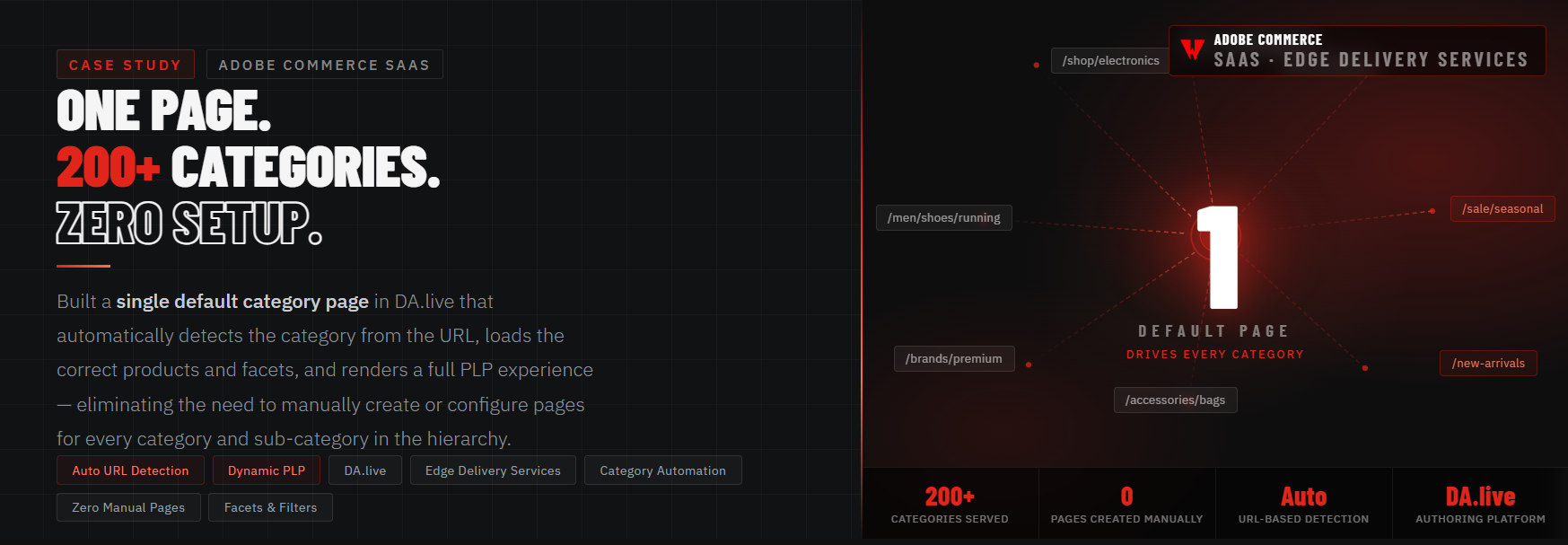
Instead of creating one DA.live page per category, enterprises should move toward a dynamic, template-driven category architecture.
In this model:
- category URLs are resolved dynamically
- Commerce becomes the source of truth
- reusable templates handle rendering
- content blocks can still be injected where needed
This significantly reduces manual effort while maintaining flexibility for marketing teams.
Recommended Enterprise Strategy
The most effective approach is usually:
Dynamic-by-default + manual overrides
Meaning:
- standard categories use scalable dynamic rendering
- high-value campaign or editorial categories can still have dedicated authored experiences
This creates the right balance between:
- scalability
- governance
- SEO
- content flexibility
Final Thoughts
Edge Delivery Services offers tremendous flexibility for modern commerce experiences, but enterprise catalogs require architectural thinking beyond page-by-page authoring.
For organizations managing hundreds or thousands of categories, scalable commerce experiences depend on:
- reusable templates
- dynamic rendering
- composable architectures
- reduced operational dependency on manual page creation
At Fruition, we see this as one of the key architectural shifts enterprises must consider while modernizing commerce experiences on EDS.